Birth chart calculator
This birth chart calculator gives your Sun, Moon and rising sign, all ten planets, the midheaven, houses and aspects — calculated from your birth date, time and place, with the method shown.
18 pages · printable
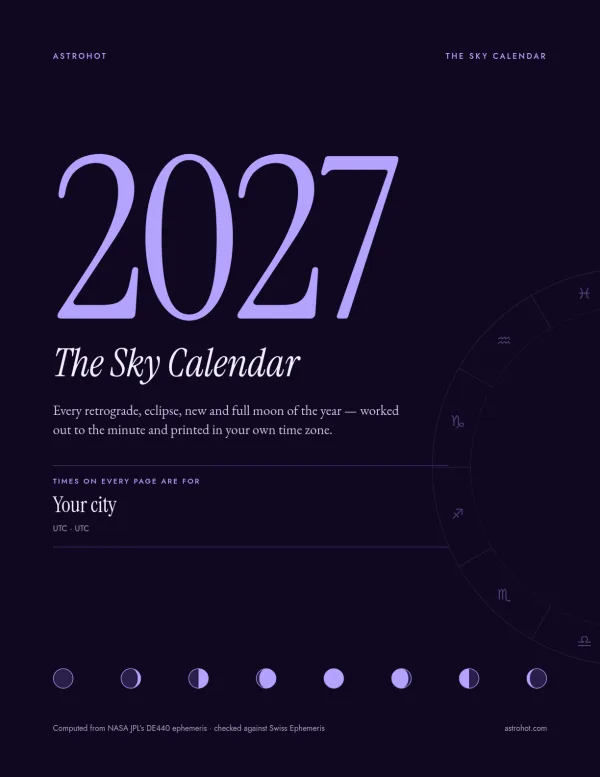
The 2027 Sky Calendar — free PDF
Every retrograde, eclipse, new and full moon of 2027 to the minute, already converted to your city. A month to a page, ready to print.
The sky right now
Where the Sun, Moon and planets are at 9:01 AM UTC, October 28, 2026 — the same calculation the chart above uses, for this moment instead of your birth.
Su Sun · Mo Moon · Me Mercury · Ve Venus · Ma Mars · Ju Jupiter · Sa Saturn · Ur Uranus · Ne Neptune · Pl Pluto. Dashed circle: retrograde.
| Planet | Sign | Degree | Motion |
|---|---|---|---|
| ☉ Sun | Scorpio | 5.0° | direct |
| ☽ Moon | Gemini | 4.9° | direct |
| ☿ Mercury | Scorpio | 19.8° | retrograde |
| ♀ Venus | Libra | 28.2° | retrograde |
| ♂ Mars | Leo | 16.8° | direct |
| ♃ Jupiter | Leo | 23.9° | direct |
| ♄ Saturn | Aries | 9.5° | retrograde |
| ♅ Uranus | Gemini | 4.8° | retrograde |
| ♆ Neptune | Aries | 2.2° | retrograde |
| ♇ Pluto | Aquarius | 3.1° | direct |
How to read your birth chart
- Start with the big three. The Sun sign describes your core purpose and the way you shine; the Moon sign describes emotional needs and what makes you feel safe; the rising sign describes how you meet the world and how others first see you. Most of what feels personal in a chart is already in these three.
- Then read each planet as a function. Mercury is how you think and talk, Venus what you love and value, Mars how you act and fight, Jupiter where you grow, Saturn where you work hardest. The sign a planet sits in shows how that function behaves, and the house shows the area of life where it plays out — Venus in Gemini in the tenth house is affection expressed through words, showing up at work.
- Look at the aspects last. Aspects are the angles between planets: conjunctions fuse two functions, trines and sextiles let them cooperate, squares and oppositions set them in tension. The tightest aspects — the smallest orbs — are usually the loudest themes in a chart.
- Notice what repeats. Several planets in one element or one house, or the same theme showing up through a sign, a house and an aspect, is what a real reading is built on. Single placements read in isolation are where generic horoscope text comes from.
What you need, and what happens without it
Date gives the Sun and planets — enough for their signs and aspects. Time fixes the Moon to within a few degrees and makes the ascendant, midheaven and houses possible; the ascendant moves a degree every four minutes, so even half an hour matters. Place sets the latitude and longitude the horizon is calculated for, and the time zone used to turn your local birth time into UTC with the daylight-saving rules of that day. A birth certificate or hospital record is the most reliable source for the time; a family memory of “around lunchtime” is enough for the Moon but not for the rising sign — the rising sign calculator shows how much it can shift.
Why the big three matter more than the Sun alone
The Sun sign is one twelfth of a chart and the only part most people know. The Moon describes what you need rather than what you are, and the ascendant describes how you arrive in a room. Two people sharing a Sun sign but nothing else often recognize almost nothing of each other in it — which is the usual reason astrology gets dismissed after one horoscope column.
Cite this page
AstroHot. “Birth Chart Calculator: Free Natal Chart, Houses, Aspects.” Accessed October 28, 2026. https://astrohot.com/birth-chart/
For Wikipedia
{{cite web |title=Birth Chart Calculator: Free Natal Chart, Houses, Aspects |url=https://astrohot.com/birth-chart/ |website=AstroHot |access-date=2026-10-28}}