Last reviewed October 11, 2026
Editorial policy
How AstroHot decides what to publish, which sources count, how statements of fact are checked, and what happens when we get something wrong.
Two kinds of content, kept apart
Everything on AstroHot is one of two things. Calculations — planetary positions, sign dates, moon phases, numerological reductions, statistics — are computed in our own code, and the formulas and their accuracy are published on the methodology page. Interpretations — what a card, a rune, a sign or a dream is said to mean — belong to traditions, and we present them as tradition: “read as”, “traditionally linked to”, never as established fact or prediction.
What counts as a source
We rely on, in this order:
- Primary texts — for each tradition, an early text quoted from its original edition:
- astrology: Ptolemy’s Tetrabiblos (about AD 150) and William Lilly’s Christian Astrology (1647);
- stones: Pliny’s Natural History (AD 77) and George Kunz’s Curious Lore of Precious Stones (1913);
- runes: the Anglo-Saxon, Norwegian and Icelandic rune poems;
- the Chinese zodiac animals: Wang Chong’s Lun-hêng (about AD 80);
- the I Ching: James Legge’s 1882 translation;
- tarot: Waite’s Pictorial Key to the Tarot (1911);
- dreams: Felix Fontaine’s Golden Wheel Dream-Book (1862);
- superstitions: nineteenth-century folklore collections such as Harland and Wilkinson’s Lancashire Folk-Lore (1867);
- aura colors: Besant and Leadbeater’s Thought-Forms (1905);
- palmistry: Cheiro’s Palmistry for All (1916).
- Research — peer-reviewed studies for any statistic about people, such as how common a dream is, with the study named next to the figure.
- Official data — NASA JPL for planetary positions, national observatories for calendar dates, gemological institutes for mineral data.
- Our own data — figures we compute and publish as open datasets, with the method and how each was checked.
Other astrology websites are not sources, however often they repeat a claim. A story that appears everywhere but nowhere in the record of its own time is reported as unproven — see myths, checked against the sources.
How old are the texts we quote?
Younger than most people expect. Of the 11 dated texts above, 7 were printed between 1862 and 1916, so a meaning described as ancient often reaches us through a book of the late nineteenth or early twentieth century. Only 3 come from antiquity.
The rune poems are left out because their dates are disputed. Dates marked “c.” are approximate.
How statements of fact are checked
Every statement that can be wrong — a date, a name, a number, an attribution, a research result — is checked against a source before it is published. In October 2026 we re-checked every such statement on the site, 1,969 in all, against primary texts, research and official data; more than 120 were corrected or removed. Typical fixes: a rune said to appear on an inscription that does not contain it, a dream study credited to the wrong university, dream themes marked “not measured” that the standard survey does measure.
Numbers we calculate are checked against an independent reference, and the result of each check is stated with the figure:
- every station, sign change and moon phase from 1900 to 2050 (Moon sign changes from 1990) comes from NASA JPL’s DE440 ephemeris and was recomputed with Swiss Ephemeris — 27,607 moments, compared on the methodology page;
- eclipses are matched against NASA’s list for 2024–2030;
- the ascendant is tested at sunrise, when it must equal the Sun’s longitude.
Tradition, evidence and advice
No controlled study has shown that astrology, tarot, numerology or any other system on this site predicts events, and we do not claim otherwise. Where research has tested a claim, we report the result, including when it is negative. We do not give medical, financial, legal or psychological advice; the disclaimer says where to go instead.
Corrections
If something is wrong, write to us through the contact page with the page, the statement and your source. Confirmed errors are corrected on the page; corrections to our datasets go into the next build, and the build date is shown on each dataset’s page. We correct calculation errors whoever reports them and credit the report if you wish.
Independence
AstroHot is funded by advertising. Advertisers have no say over what we publish, and we do not accept paid links or sponsored articles that are not labeled as such. How advertising and cookies work on the site is set out in the privacy policy.
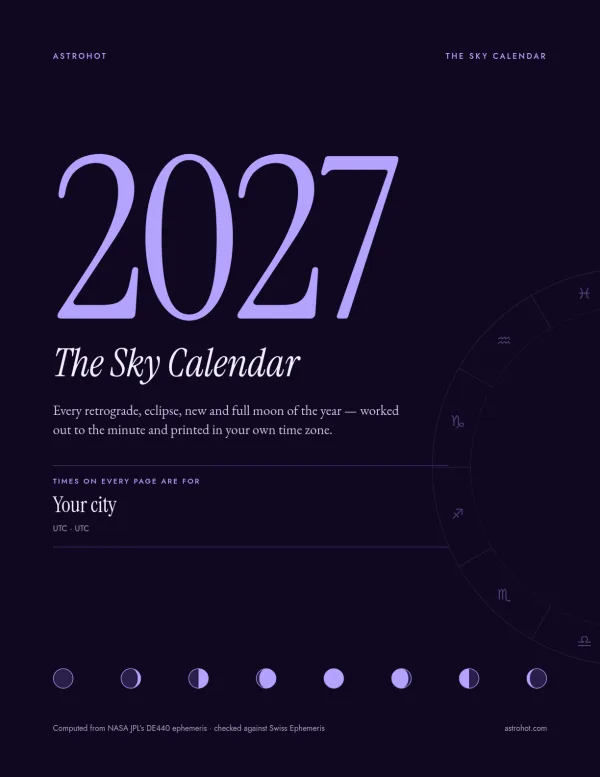
18 pages · printable
The 2027 Sky Calendar — free PDF
Every retrograde, eclipse, new and full moon of 2027 to the minute, already converted to your city. A month to a page, ready to print.
Cite this page
AstroHot. “Editorial Policy — Sources, Fact-Checking and Corrections.” Accessed November 26, 2026. https://astrohot.com/editorial-policy/
For Wikipedia
{{cite web |title=Editorial Policy — Sources, Fact-Checking and Corrections |url=https://astrohot.com/editorial-policy/ |website=AstroHot |access-date=2026-11-26}}