Divination
Divination is the practice of reading a random draw as if it carried meaning. This section lays out each system in full — all 78 tarot cards, 36 Lenormand cards, 24 runes and 64 hexagrams, not the handful everyone quotes — and treats each as a structure with rules rather than a list to memorize.
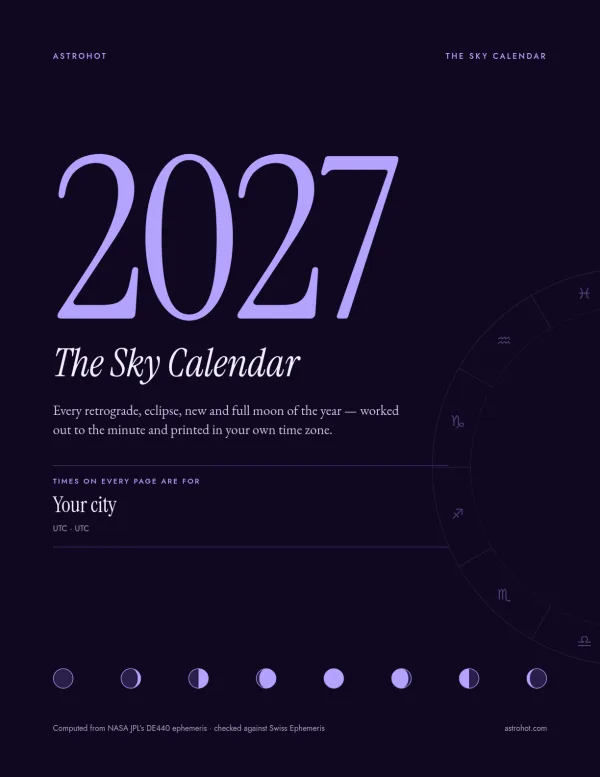
18 pages · printable
The 2027 Sky Calendar — free PDF
Every retrograde, eclipse, new and full moon of 2027 to the minute, already converted to your city. A month to a page, ready to print.
How many different answers can one draw give?
A single rune can come up 41 ways and a tarot card 156, counting reversals. Six throws of three coins give 4,096 distinct results, because each of the 64 hexagrams can arrive with any combination of changing lines. Three tarot cards in order already reach 3,651,648.
One Lenormand card: 36 cards, read upright · One rune: 24 staves + 17 reversed · One tarot card: 78 cards × upright or reversed · One I Ching cast: 64 hexagrams × 64 sets of changing lines · Three-card tarot spread: 78 × 77 × 76 orders × 8 reversal patterns. Logarithmic scale.
What we do differently here
Nine runes look the same upside down
Their shapes survive a half-turn, so an upside-down draw cannot be told from an upright one. Seven of them are read upright only; Nauthiz and Eihwaz keep the reversed readings modern rune books give them, which go by how the stave falls rather than its outline — leaving 17 of the 24 with a reversed meaning, a fact that changes how a spread is read.
The minor arcana is a system, not 56 separate cards
Four suits, ten numbers and four courts. Once the grid is visible, a card you have never seen becomes readable from its position in it — which is why we lay out all 78 rather than the famous dozen.
The I Ching hexagrams are built, not listed
Sixty-four combinations of eight trigrams, each with a nuclear, opposite and inverse relative. Those relations are computed here, so you can see how one hexagram sits against the others instead of reading it in isolation.
One palmistry claim has actually been tested
That a short life line means a short life: a 1990 study reported a link, and a 2019 re-test on 60 cadavers found none. Most other claims have never been tested at all, and the palm reading page says which is which, because the difference between untested and disproven is the one thing worth knowing here.
The systems are younger — and older — than they sound
The core text of the I Ching goes back nearly three thousand years, to the Western Zhou dynasty. Runes were an alphabet from about the second century AD; rune divination as practiced today is largely a twentieth-century revival. Tarot cards were a fifteenth-century Italian game, first used for fortune-telling in eighteenth-century France, and the Lenormand deck was published after the death, in 1843, of the Parisian fortune-teller whose name it borrows.
A fixed draw, not a reshuffle
Every card, rune and hexagram drawn on this site comes from a seeded shuffle, so a reading keeps its link and stays the same when you reload it. If an answer changes every time the page refreshes, no answer was given in the first place.
What the evidence says
No controlled study has shown that a card, rune or line on the palm predicts events. What divination reliably does is make people put a question into words and look at it from a new angle — and the Barnum effect, our readiness to accept general statements as personal, explains much of why readings feel accurate.
Cite this page
AstroHot. “Divination Systems: Tarot, Runes, I Ching and Palmistry.” Accessed October 29, 2026. https://astrohot.com/divination/
For Wikipedia
{{cite web |title=Divination Systems: Tarot, Runes, I Ching and Palmistry |url=https://astrohot.com/divination/ |website=AstroHot |access-date=2026-10-29}}