The outer world
Learning to act, love and lead: the lessons of growing up and making a place in the world.
The Magician · The High Priestess · The Empress · The Emperor · The Hierophant · The Lovers · The Chariot
Structure, not memorization
How to read tarot cards without learning 78 of them: the 56 minor arcana are four suits crossed with ten numbers and four court ranks — 18 things to learn, and the grid produces the rest. Only the 22 majors are genuinely individual. Most beginners quit because they start by memorizing, which is the slowest possible route.
The arithmetic of learning it
Four suits times ten numbers is forty cards, plus sixteen courts. Learn the suit and learn the number, and the Five of Cups becomes readable without ever having seen it.
Learning by structure leaves 40 items instead of 78: four suits, ten numbers and four court ranks stand in for all 56 minor cards, and only the 22 majors still need learning one by one.
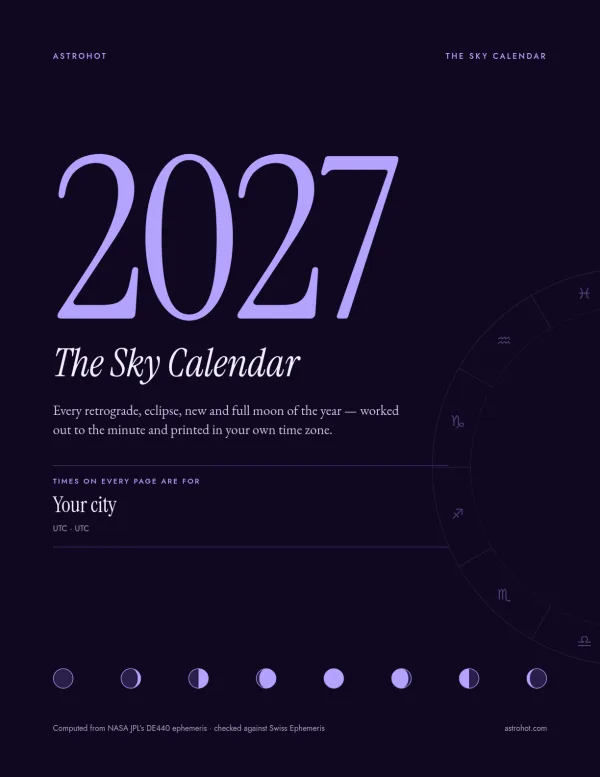
18 pages · printable
Every retrograde, eclipse, new and full moon of 2027 to the minute, already converted to your city. A month to a page, ready to print.
Put a number and a suit together and the card reads itself: the Five of Pentacles is disruption in money and health, the Six of Cups is harmony in feeling, the Knight of Swords is thought charging ahead. Check against the card pages afterward, not before.
The 22 majors are the ones worth learning individually, and they are easier as a story. Set the Fool aside as the traveler, and lay the other 21 in three rows of seven — a teaching arrangement many modern tarot writers use.
Learning to act, love and lead: the lessons of growing up and making a place in the world.
The Magician · The High Priestess · The Empress · The Emperor · The Hierophant · The Lovers · The Chariot
Strength, solitude, fate and loss — the turn inward once outward success is not enough.
Strength · The Hermit · Wheel of Fortune · Justice · The Hanged Man · Death · Temperance
Temptation, upheaval, hope and completion — the forces larger than any one person.
The Devil · The Tower · The Star · The Moon · The Sun · Judgement · The World
Before reading any card on its own, look at the spread from a distance. Count the majors: several in a small spread point to big themes or forces outside your control; none suggests the matter is in your hands. Look for the dominant suit: mostly Cups is about feelings, mostly Pentacles about money or the body. Notice repeated numbers: three Fives say conflict is the theme, whatever the suits.
Then read the cards in order as a sentence, letting each position change the meaning. The Tower in a past position is a shock that is over; in the outcome position it is a warning. Where two cards seem to contradict each other, the tension is usually the message.
If you use reversals, decide how before you shuffle. The common readings are the opposite of the upright meaning, the same energy blocked or delayed, or the energy turned inward. Pick one and apply it consistently; switching between them to avoid an unwelcome answer defeats the purpose.
Open questions work better than predictions. "What do I need to understand about this job?" gives the cards something to describe; "Will I get the job?" invites a yes or no and little else. Write the question down before shuffling so it cannot quietly change to fit the cards.
Draw one card each morning, write down what you think it means before looking it up, and note in the evening what the day actually brought. After a month you will have met a third of the deck in your own words — the card of the day is built for exactly this. Move to three-card spreads when single cards feel familiar, and leave the Celtic Cross until you can read a three-card spread without the book.
Reading is a skill of association, and it does not develop from a book. Draw three cards, say out loud what the suit and number suggest, then look up the meaning and notice where you were close.
Start with a three-card spread: it forces you to separate what has happened from what is happening from what you are doing about it, which is most of the value of the layout regardless of the cards.
Reversals are optional at the start. They are a convention rather than a rule, and plenty of experienced readers ignore them entirely.
AstroHot. “How to Read Tarot Cards: The Structure, Not the Memorization.” Accessed October 29, 2026. https://astrohot.com/tarot/how-to-read/
{{cite web |title=How to Read Tarot Cards: The Structure, Not the Memorization |url=https://astrohot.com/tarot/how-to-read/ |website=AstroHot |access-date=2026-10-29}}
Free · PDF · 18 pages
Every retrograde, eclipse, new and full moon of 2027 — to the minute, printed in your own time zone.