Eihwaz upright
Endurance through a hard passage. The yew is poisonous and near-immortal — the rune of surviving what should have finished you.
Rune 13 of 24 · Heimdall's Aett
Eihwaz rune meaning: endurance through a hard passage. Its name is read as “yew tree”; it is rune 13 of 24, in Heimdall's Aett, with the sound ei. Reversed: confusion, weakness, or avoiding a passage that must be crossed.
Dickins, Runic and Heroic Poems, 1915.
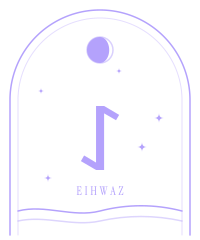
Endurance through a hard passage. The yew is poisonous and near-immortal — the rune of surviving what should have finished you.
Confusion, weakness, or avoiding a passage that must be crossed.
18 pages · printable
Every retrograde, eclipse, new and full moon of 2027 to the minute, already converted to your city. A month to a page, ready to print.
Eihwaz is rune 13, the fifth of the eight in Heimdall's Aett, between Jera and Perthro.
Its shape is one of the 9 in the row that look the same after a half-turn, so an upside-down draw cannot be seen. The reversed reading above comes from modern rune books, which read how the stave falls rather than its outline.
In a reading
Eihwaz, the yew, stands for endurance, protection and the link between life and death. It often appears when a situation requires steady resilience.
A bond that survives difficulty.
Perseverance through a long or testing project.
Stay rooted; endurance is the strength here.
Primary source
In brief, the Anglo-Saxon verse describes the yew as rough-barked and deeply rooted, a keeper of fire and a welcome sight on an estate.
“The yew is a tree with rough bark, hard and fast in the earth, supported by its roots, a guardian of flame and a joy upon an estate.”
“Yew is the greenest of trees in winter; it is wont to crackle when it burns.”
“Yr — bent bow and brittle iron and giant of the arrow.”
The Anglo-Saxon and Norwegian verses are about the yew; the Icelandic one is about yr, a bent bow.
| Source | Name | The verse is about |
|---|---|---|
| Elder Futhark name (reconstructed) | Eihwaz | yew tree |
| Anglo-Saxon rune poem | eoh | the yew |
| Norwegian rune poem | ýr | the yew |
| Icelandic rune poem | ýr | yr, a bent bow |
Subjects in the words of Dickins’s 1915 translation; the first row is the modern reconstructed name and reading.
Calculated
In 2026 the date-seeded draw lands on Eihwaz only 13 times, under the even share of 15.2, which puts it joint 18th of 24 with one other rune. It lies reversed on 2 of them. September is its busiest month, with 3. Its longest gap between draws, from May 22 to July 12, spans 51 days.
Days in 2026:
Which runes can be reversed, and how the daily draw is fixed →
What happened to it
Dropped from the Younger Futhark, but its name, yew, passed to the ýr rune, which took its shape from algiz.
One of the least attested runes, and its exact original sound is still argued over.
The poem above is a source; this table is a twentieth-century reconstruction.
| Character | ᛇ |
|---|---|
| Code point | U+16C7 |
| Unicode name | RUNIC LETTER IWAZ EOH |
| HTML | ᛇ or ᛇ |
The Unicode standard names it Iwaz, not Eihwaz, and its name also records Eoh.
Copy the character, or paste the code into a web page; it shows wherever a font covers the Runic block, added in Unicode 3.0.
Statements of fact on this page were checked against these sources in October 2026. How we choose and check sources: editorial policy.
AstroHot. “Eihwaz Rune Meaning: Yew Tree.” Accessed October 27, 2026. https://astrohot.com/runes/eihwaz/
{{cite web |title=Eihwaz Rune Meaning: Yew Tree |url=https://astrohot.com/runes/eihwaz/ |website=AstroHot |access-date=2026-10-27}}
Free · PDF · 18 pages
Every retrograde, eclipse, new and full moon of 2027 — to the minute, printed in your own time zone.