Kenaz upright
Illumination and craft. Knowledge that can be applied — the controlled fire of the forge rather than the wildfire.
Rune 6 of 24 · Freyr's Aett
Kenaz rune meaning: illumination and craft. Its name is read as “torch, fire”; it is rune 6 of 24, in Freyr's Aett, with the sound k. Reversed: the light going out.
Dickins, Runic and Heroic Poems, 1915.
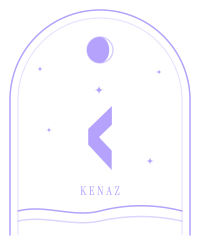
Illumination and craft. Knowledge that can be applied — the controlled fire of the forge rather than the wildfire.
The light going out. Loss of clarity, creative block, or a skill neglected.
18 pages · printable
Every retrograde, eclipse, new and full moon of 2027 to the minute, already converted to your city. A month to a page, ready to print.
Kenaz is rune 6, the sixth of the eight in Freyr's Aett, between Raidho and Gebo.
In a reading
Kenaz is the torch: knowledge, creativity and seeing clearly. It often appears when an idea or skill is ready to be developed.
Warmth, attraction and clarity about feelings.
Creative work, learning a craft and bringing ideas to light.
Use what you understand to make something.
Primary source
In brief, the Anglo-Saxon verse speaks of the torch as a bright flame everyone recognizes, burning in the hall where nobles gather.
“The torch is known to every living man by its pale, bright flame; it always burns where princes sit within.”
“Ulcer is fatal to children; death makes a corpse pale.”
“Ulcer — disease fatal to children and painful spot and abode of mortification.”
The Norwegian and Icelandic poems agree on an ulcer; the Anglo-Saxon verse is about the torch.
| Source | Name | The verse is about |
|---|---|---|
| Elder Futhark name (reconstructed) | Kenaz | torch, fire |
| Anglo-Saxon rune poem | cen | the torch |
| Norwegian rune poem | kaun | an ulcer |
| Icelandic rune poem | kaun | an ulcer |
Subjects in the words of Dickins’s 1915 translation; the first row is the modern reconstructed name and reading.
Calculated
In 2026 the date-seeded draw lands on Kenaz only 9 times, under the even share of 15.2, which puts it joint 23rd of 24 with one other rune. It lies reversed on 2 of them. Its longest gap between draws, from May 11 to July 16, spans 66 days.
Days in 2026:
Which runes can be reversed, and how the daily draw is fixed →
What happened to it
Survived as kaun, ulcer — the meaning both Scandinavian rune poems give it.
The name Kenaz and the meaning torch come from the Anglo-Saxon cen; the Proto-Germanic name is usually reconstructed from the Norse one, as *kaunan, ulcer — so the darker sense may well be the older.
The poem above is a source; this table is a twentieth-century reconstruction.
| Character | ᚲ |
|---|---|
| Code point | U+16B2 |
| Unicode name | RUNIC LETTER KAUNA |
| HTML | ᚲ or ᚲ |
The Unicode standard names it Kauna, not Kenaz.
Copy the character, or paste the code into a web page; it shows wherever a font covers the Runic block, added in Unicode 3.0.
Statements of fact on this page were checked against these sources in October 2026. How we choose and check sources: editorial policy.
AstroHot. “Kenaz Rune Meaning: Torch, Fire.” Accessed October 27, 2026. https://astrohot.com/runes/kenaz/
{{cite web |title=Kenaz Rune Meaning: Torch, Fire |url=https://astrohot.com/runes/kenaz/ |website=AstroHot |access-date=2026-10-27}}
Free · PDF · 18 pages
Every retrograde, eclipse, new and full moon of 2027 — to the minute, printed in your own time zone.