Isa upright
Stillness and suspension. Everything held in place — frustrating if you want movement, useful if you needed to stop.
Rune 11 of 24 · Heimdall's Aett
Isa rune meaning: stillness and suspension. Its name is read as “ice”; it is rune 11 of 24, in Heimdall's Aett, with the sound i. The shape looks the same upside down, so there is no reversed reading.
Dickins, Runic and Heroic Poems, 1915.
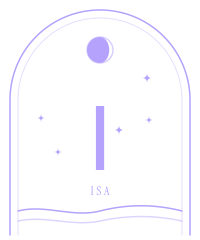
Stillness and suspension. Everything held in place — frustrating if you want movement, useful if you needed to stop.
Isa is symmetrical — turning it over changes nothing, so it has no reversed meaning.
18 pages · printable
Every retrograde, eclipse, new and full moon of 2027 to the minute, already converted to your city. A month to a page, ready to print.
Isa is rune 11, the third of the eight in Heimdall's Aett, between Nauthiz and Jera.
Its shape is one of the 9 in the row that look the same after a half-turn, so an upside-down draw cannot be seen. It has no reversed reading here.
In a reading
Isa is ice: stillness, standstill and waiting. Nothing moves for now, and forcing it risks slipping.
A cooling or pause; give each other time.
A freeze on progress; plan while waiting for the thaw.
Be still and let clarity form.
Primary source
In brief, the Anglo-Saxon verse describes ice as very cold and slippery, yet glittering like jewels and beautiful to look at.
“Ice is very cold and immeasurably slippery; it glistens as clear as glass and most like to gems; it is a floor wrought by the frost, fair to look upon.”
“Ice we call the broad bridge; the blind man must be led.”
“Ice — bark of rivers and roof of the wave and destruction of the doomed.”
All three poems agree: the verse for Isa is about ice.
| Source | Name | The verse is about |
|---|---|---|
| Elder Futhark name (reconstructed) | Isa | ice |
| Anglo-Saxon rune poem | is | ice |
| Norwegian rune poem | íss | ice |
| Icelandic rune poem | íss | ice |
Subjects in the words of Dickins’s 1915 translation; the first row is the modern reconstructed name and reading.
Calculated
In 2026 the date-seeded draw lands on Isa only 9 times, under the even share of 15.2, which puts it joint 23rd of 24 with one other rune. Its longest gap between draws, from April 25 to June 29, spans 65 days.
Days in 2026:
Which runes can be reversed, and how the daily draw is fixed →
What happened to it
Survived as íss, ice. A single vertical stroke, and the simplest rune to carve.
The Icelandic rune poem calls ice 'bark of rivers and roof of the wave and destruction of the doomed'.
The poem above is a source; this table is a twentieth-century reconstruction.
| Character | ᛁ |
|---|---|
| Code point | U+16C1 |
| Unicode name | RUNIC LETTER ISAZ IS ISS I |
| HTML | ᛁ or ᛁ |
The Unicode standard names it Isaz, not Isa, and its name also records Is and Iss.
Copy the character, or paste the code into a web page; it shows wherever a font covers the Runic block, added in Unicode 3.0.
Statements of fact on this page were checked against these sources in October 2026. How we choose and check sources: editorial policy.
AstroHot. “Isa Rune Meaning: Ice.” Accessed October 27, 2026. https://astrohot.com/runes/isa/
{{cite web |title=Isa Rune Meaning: Ice |url=https://astrohot.com/runes/isa/ |website=AstroHot |access-date=2026-10-27}}
Free · PDF · 18 pages
Every retrograde, eclipse, new and full moon of 2027 — to the minute, printed in your own time zone.