Upper trigram
☷
Earth (Kun) above
Receptive yielding.
FamilyMother
ElementEarth
Hexagram 2 of 64
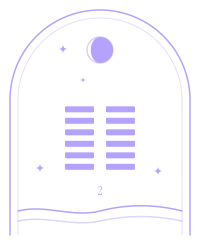
I Ching hexagram 2, The Receptive, is earth above, earth below. In brief: pure yielding — strength through accepting rather than pushing. All six of its lines are broken, which makes it pure yin.
Legge, The Yî King, 1882.
Upper trigram
Receptive yielding.
Lower trigram
Receptive yielding.
18 pages · printable
Every retrograde, eclipse, new and full moon of 2027 to the minute, already converted to your city. A month to a page, ready to print.
What the text says, in plain terms
The Judgement
A time to receive and support rather than lead. Success comes from following a good direction faithfully, like a mare that keeps pace, instead of trying to set the course yourself.
The Image
Earth doubled: wide, open ground that carries everything placed on it. The lesson is generous capacity — strength shown by holding and nurturing, not by pushing.
A summary of meaning written for this site, not a translation — James Legge’s 1882 translation of the full text follows below. How the Judgement and the Image are read, and which translations to use →
Primary source
“Khwăn (represents) what is great and originating, penetrating, advantageous, correct and having the firmness of a mare. When the superior man (here intended) has to make any movement, if he take the initiative, he will go astray; if he follow, he will find his (proper) lord. The advantageousness will be seen in his getting friends in the south-west, and losing friends in the north-east. If he rest in correctness and firmness, there will be good fortune.”
“The (capacity and sustaining) power of the earth is what is denoted by Khwăn. The superior man, in accordance with this, with his large virtue supports (men and) things.”
Let someone or something else set the direction, and put your effort into carrying it out well. Trying to take the lead now tends to misfire; responding thoughtfully to what arrives works far better.
Devotion, patience and practical care. The hexagram favors listening and supporting, with the reminder that receptive is not the same as silent — needs still have to be named.
Good for supporting roles, teamwork and steady execution of a plan made by others. Quiet reliability is noticed later, even if not at once.
Read from the bottom up. This figure runs yin yin yin yin yin yin — what each position means.
All six lines are yin. Three of the six stand in their proper place, and none of the three pairs answer each other.
Earth below — receptive yielding — is the private, inner side of hexagram 2.
Earth above — receptive yielding — is the world that side meets.
Both trigrams are Earth, so nothing in the figure pulls against anything else. That makes the reading unusually single-minded — and unusually short of internal correction.
The mother sits both above and below. The same figure doubled — the purest form of what the trigram describes.
Calculated from the lines
Nuclear hexagram
What is happening beneath the surface.
Lines 2–4 give Kun (Earth) as the lower trigram, lines 3–5 give Kun (Earth) as the upper.
Opposite hexagram
The situation turned inside out.
Change all six lines and Earth over Earth becomes Heaven over Heaven.
Inverse hexagram
Hexagram 2 reads the same upside down: Earth over Earth, turned over, is still Earth over Earth. Only eight of the sixty-four do.
None of these are assigned by an author — each follows from the arrangement of lines.
Earth above, Earth below.
Earth over Earth: receptive yielding meeting receptive yielding.
Statements of fact on this page were checked against these sources in October 2026. How we choose and check sources: editorial policy.
AstroHot. “I Ching Hexagram 2: The Receptive.” Accessed October 27, 2026. https://astrohot.com/i-ching/hexagram/2/
{{cite web |title=I Ching Hexagram 2: The Receptive |url=https://astrohot.com/i-ching/hexagram/2/ |website=AstroHot |access-date=2026-10-27}}
Free · PDF · 18 pages
Every retrograde, eclipse, new and full moon of 2027 — to the minute, printed in your own time zone.