Upper trigram
☰
Heaven (Qian) above
Creative force.
FamilyFather
ElementMetal
Hexagram 6 of 64
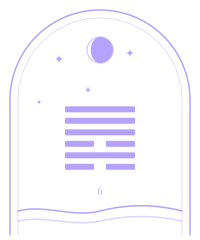
I Ching hexagram 6, Conflict, is heaven above, water below. In brief: opposition that cannot be resolved by force. Counting from the bottom, its solid lines sit in places 2, 4, 5 and 6 and its broken lines in 1 and 3.
Legge, The Yî King, 1882.
Upper trigram
Creative force.
Lower trigram
Danger and depth.
18 pages · printable
Every retrograde, eclipse, new and full moon of 2027 to the minute, already converted to your city. A month to a page, ready to print.
What the text says, in plain terms
The Judgement
A conflict where you may well be in the right, yet pressing it to the end still causes harm. The wise course is to seek a fair mediator and stop halfway rather than fight to victory.
The Image
Heaven and water moving in opposite directions. The lesson is to think carefully at the start of any undertaking so that the seeds of conflict are not planted.
A summary of meaning written for this site, not a translation — James Legge’s 1882 translation of the full text follows below. How the Judgement and the Image are read, and which translations to use →
Primary source
“Sung intimates how, though there is sincerity in one’s contention, he will yet meet with opposition and obstruction; but if he cherish an apprehensive caution, there will be good fortune, while, if he must prosecute the contention to the (bitter) end, there will be evil. It will be advantageous to see the great man; it will not be advantageous to cross the great stream.”
“(The trigram representing) heaven and (that representing) water, moving away from each other, form Sung. The superior man, in accordance with this, in the transaction of affairs takes good counsel about his first steps.”
Avoid escalating. Get a neutral opinion, settle for a fair compromise and do not begin a major new venture while the dispute is open. Being right does not guarantee that fighting is worth it.
Arguments where both sides feel justified. The advice is to stop trying to win and look for terms both people can live with.
Disputes, negotiations and legal matters. Mediation and clear agreements at the outset serve better than a long contest.
Read from the bottom up. This figure runs yin yang yin yang yang yang — what each position means.
4 yang and 2 yin lines. One of the six stands in its proper place, and the pairs 1–4 and 3–6 answer.
Water below — danger and depth — is the private, inner side of hexagram 6.
Heaven above — creative force — is the world that side meets.
Metal above generates Water below, so the movement runs downward — the outer situation is feeding the inner one. Support arrives from outside rather than being generated within.
The father sits above and the middle son below. A parent over a child, which the tradition reads as guidance, authority or constraint depending on the rest of the figure.
Calculated from the lines
Nuclear hexagram
What is happening beneath the surface.
Lines 2–4 give Li (Fire) as the lower trigram, lines 3–5 give Xun (Wind) as the upper.
Opposite hexagram
The situation turned inside out.
Change all six lines and Heaven over Water becomes Earth over Fire.
Inverse hexagram
The situation seen from the other side.
Turn the figure upside down and Heaven over Water becomes Water over Heaven.
None of these are assigned by an author — each follows from the arrangement of lines.
Heaven above, Water below.
Heaven over Water: creative force meeting danger and depth.
Statements of fact on this page were checked against these sources in October 2026. How we choose and check sources: editorial policy.
AstroHot. “I Ching Hexagram 6: Conflict.” Accessed October 27, 2026. https://astrohot.com/i-ching/hexagram/6/
{{cite web |title=I Ching Hexagram 6: Conflict |url=https://astrohot.com/i-ching/hexagram/6/ |website=AstroHot |access-date=2026-10-27}}
Free · PDF · 18 pages
Every retrograde, eclipse, new and full moon of 2027 — to the minute, printed in your own time zone.