Upper trigram
☵
Water (Kan) above
Danger and depth.
FamilyMiddle son
ElementWater
Hexagram 3 of 64
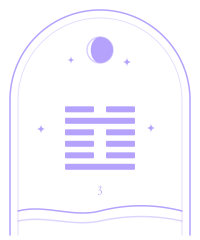
I Ching hexagram 3, Difficulty at the Beginning, is water above, thunder below. In brief: a hard start; growth held back by early chaos. Counting from the bottom, its solid lines sit in places 1 and 5 and its broken lines in 2, 3, 4 and 6.
Legge, The Yî King, 1882.
Upper trigram
Danger and depth.
Lower trigram
Arousal and shock.

18 pages · printable
Every retrograde, eclipse, new and full moon of 2027 to the minute, already converted to your city. A month to a page, ready to print.
What the text says, in plain terms
The Judgement
The confusion of a new beginning. Growth is happening but everything is tangled; progress comes from getting help and putting basic order in place before pushing ahead.
The Image
Water above thunder: a storm cloud gathering over new growth. The lesson is to sort things out — separate the threads, build structure — while the situation is still forming.
A summary of meaning written for this site, not a translation — James Legge’s 1882 translation of the full text follows below. How the Judgement and the Image are read, and which translations to use →
Primary source
“Kun (indicates that in the case which it presupposes) there will be great progress and success, and the advantage will come from being correct and firm. (But) any movement in advance should not be (lightly) undertaken. There will be advantage in appointing feudal princes.”
“(The trigram representing) clouds and (that representing) thunder form Kun. The superior man, in accordance with this, (adjusts his measures of government) as in sorting the threads of the warp and woof.”
Do not force a big move while the situation is still chaotic. Line up allies, clarify roles and take small steps. The difficulty belongs to the start and eases once the pieces are arranged.
Early stages that feel awkward or overwhelming. The advice is patience and outside support rather than giving up because the beginning is messy.
A launch, a new job or a new team in its first chaotic phase. Build simple systems, ask for help and resist taking on more before the basics work.
Read from the bottom up. This figure runs yang yin yin yin yang yin — what each position means.
2 yang and 4 yin lines. Five of the six stand in their proper place, and the pairs 1–4 and 2–5 answer.
Thunder below — arousal and shock — is the private, inner side of hexagram 3.
Water above — danger and depth — is the world that side meets.
Water above generates Wood below, so the movement runs downward — the outer situation is feeding the inner one. Support arrives from outside rather than being generated within.
The middle son sits above and the eldest son below. Two brothers, the younger one on top — siblings rather than parent and child, with the junior one taking the lead.
Calculated from the lines
Nuclear hexagram
What is happening beneath the surface.
Lines 2–4 give Kun (Earth) as the lower trigram, lines 3–5 give Gen (Mountain) as the upper.
Opposite hexagram
The situation turned inside out.
Change all six lines and Water over Thunder becomes Fire over Wind.
Inverse hexagram
The situation seen from the other side.
Turn the figure upside down and Water over Thunder becomes Mountain over Water.
None of these are assigned by an author — each follows from the arrangement of lines.
Water above, Thunder below.
Water over Thunder: danger and depth meeting arousal and shock.
Statements of fact on this page were checked against these sources in October 2026. How we choose and check sources: editorial policy.
AstroHot. “I Ching Hexagram 3: Difficulty at the Beginning.” Accessed October 27, 2026. https://astrohot.com/i-ching/hexagram/3/
{{cite web |title=I Ching Hexagram 3: Difficulty at the Beginning |url=https://astrohot.com/i-ching/hexagram/3/ |website=AstroHot |access-date=2026-10-27}}
Free · PDF · 18 pages
Every retrograde, eclipse, new and full moon of 2027 — to the minute, printed in your own time zone.