What research shows
The measured food dream is a pleasant one — eating delicious foods, reported by 30.7% of students. Hunger, dieting and spoiled food were not part of the survey.
Objects
Dreaming about food is traditionally read as nourishment of some kind, not necessarily physical. It is one of the few dreams anyone has counted: in the standard survey of typical dreams, 30.7% of 1,181 students had dreamt it, the 23rd most common of 55 themes.
Share: Nielsen et al. 2003, Dreaming 13(4), Table 1, n = 1,181. Dream book: Felix Fontaine, The Golden Wheel Dream-Book and Fortune-Teller (New York: Dick & Fitzgerald, 1862).
What research shows
The measured food dream is a pleasant one — eating delicious foods, reported by 30.7% of students. Hunger, dieting and spoiled food were not part of the survey.
The psychological reading
Beyond hunger, read as what sustains you — company, work, meaning. Being unable to eat is the more pointed version.
What tradition claimed
A laden table promised abundance; spoiled food warned of illness.
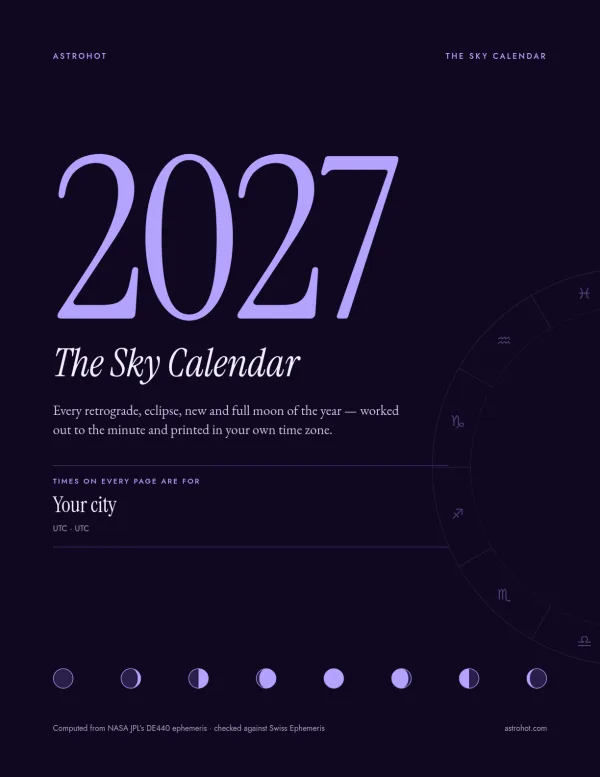
18 pages · printable
Every retrograde, eclipse, new and full moon of 2027 to the minute, already converted to your city. A month to a page, ready to print.
When it turns up
Food dreams have a direct physiological input: they rise during dieting, fasting and illness. Where that is not the story, they track sustenance in the wider sense — what is keeping you going and whether there is enough of it.
Measured, not guessed
The item is “eating delicious foods” — the measured variant, not food in general.
The same survey question also covers dreams about eating, where it is set against all 55 typical dreams, with the figures for men, women and age groups.
The version matters
Being unable to eat, or food that spoils on the plate, are distinct forms and read as frustration rather than hunger.
Abundance, and dreamers usually report the company as much as the meal. It clusters around family and holidays.
Support that arrived too late or turned out to be no good. It reads as frustration rather than hunger.
Provision you cannot make use of. It follows situations where help was offered in a form that did not fit.
Care in its most practical form. Reported during periods of looking after people.
Staples rather than treats, and both carry cultural weight around sustenance and family. The weight comes from the culture rather than the dream.
Need that cannot be admitted. It arrives around asking for help and not wanting to.
Food ranks 7th of the 111 themes here, with 2.68% of the searches; coffee leads the section at 13.8%.
The dream book of 1862. Fontaine’s entry under “Eating”, with its omens and the lottery numbers 70, 14, is quoted in full on the page about dreams of eating.
Commonly claimed, and wrong
Specific foods do not carry fixed meanings, whatever the dream dictionaries say, and food dreams are not prosperity omens. If you have been restricting what you eat, that is the explanation and it is a well-supported one.
How to record a dream, why the feeling matters more than the content, and when recurring nightmares are worth a doctor rather than a dictionary — set out once on the main page.
Asked most often
Sustenance in the broad sense, and often literal hunger. Deprivation during the day is the strongest known driver of these dreams.
Usually support that came too late or was not what you needed. It reads as frustration rather than disgust.
No. The meanings assigned to individual foods online contradict each other from source to source, which tells you how much weight to give them.
Statements of fact on this page were checked against these sources in October 2026. How we choose and check sources: editorial policy.
AstroHot. “Dreaming About Food: What It Means.” Accessed October 28, 2026. https://astrohot.com/dream-dictionary/objects/food/
{{cite web |title=Dreaming About Food: What It Means |url=https://astrohot.com/dream-dictionary/objects/food/ |website=AstroHot |access-date=2026-10-28}}
Free · PDF · 18 pages
Every retrograde, eclipse, new and full moon of 2027 — to the minute, printed in your own time zone.