Upper trigram
☳
Thunder (Zhen) above
Arousal and shock.
FamilyEldest son
ElementWood
Hexagram 51 of 64
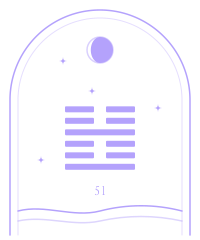
I Ching hexagram 51, The Arousing, is thunder above, thunder below. In brief: shock repeated; sudden change. Counting from the bottom, its solid lines sit in places 1 and 4 and its broken lines in 2, 3, 5 and 6.
Legge, The Yî King, 1882.
Upper trigram
Arousal and shock.
Lower trigram
Arousal and shock.
18 pages · printable
Every retrograde, eclipse, new and full moon of 2027 to the minute, already converted to your city. A month to a page, ready to print.
What the text says, in plain terms
The Judgement
Shock, like a thunderclap. Fear arrives suddenly, but someone who stays composed can even laugh afterward — the shock becomes a reason to take things seriously.
The Image
Thunder doubled, rolling on and on. The lesson is to examine yourself honestly and set your life in order when shaken.
A summary of meaning written for this site, not a translation — James Legge’s 1882 translation of the full text follows below. How the Judgement and the Image are read, and which translations to use →
Primary source
“Kăn gives the intimation of ease and development. When (the time of) movement (which it indicates) comes, (the subject of the hexagram) will be found looking out with apprehension, and yet smiling and talking cheerfully. When the movement (like a crash of thunder) terrifies all within a hundred lî, he will be (like the sincere worshipper) who is not (startled into) letting go his ladle and (cup of) sacrificial spirits.”
“(The trigram representing) thunder, being repeated, forms Kăn. The superior man, in accordance with this, is fearful and apprehensive, cultivates (his virtue), and examines (his faults).”
Something unexpected has happened. Steady yourself first, then act; use the jolt to review what needed changing anyway.
A sudden upset or revelation. Calm responses prevent a shock from becoming a lasting rupture.
Crises, surprises and sudden change. Keep your composure, communicate clearly and treat it as a wake-up call.
Read from the bottom up. This figure runs yang yin yin yang yin yin — what each position means.
2 yang and 4 yin lines. Three of the six stand in their proper place, and none of the three pairs answer each other.
Thunder below — arousal and shock — is the private, inner side of hexagram 51.
Thunder above — arousal and shock — is the world that side meets.
Both trigrams are Wood, so nothing in the figure pulls against anything else. That makes the reading unusually single-minded — and unusually short of internal correction.
The eldest son sits both above and below. The same figure doubled — the purest form of what the trigram describes.
Calculated from the lines
Nuclear hexagram
What is happening beneath the surface.
Lines 2–4 give Gen (Mountain) as the lower trigram, lines 3–5 give Kan (Water) as the upper.
Opposite hexagram
The situation turned inside out.
Change all six lines and Thunder over Thunder becomes Wind over Wind.
Inverse hexagram
The situation seen from the other side.
Turn the figure upside down and Thunder over Thunder becomes Mountain over Mountain.
None of these are assigned by an author — each follows from the arrangement of lines.
Thunder above, Thunder below.
Thunder over Thunder: arousal and shock meeting arousal and shock.
Statements of fact on this page were checked against these sources in October 2026. How we choose and check sources: editorial policy.
AstroHot. “I Ching Hexagram 51: The Arousing.” Accessed October 27, 2026. https://astrohot.com/i-ching/hexagram/51/
{{cite web |title=I Ching Hexagram 51: The Arousing |url=https://astrohot.com/i-ching/hexagram/51/ |website=AstroHot |access-date=2026-10-27}}
Free · PDF · 18 pages
Every retrograde, eclipse, new and full moon of 2027 — to the minute, printed in your own time zone.