Synastry aspect · 120° · orb 8°
Juno Trine Node Synastry
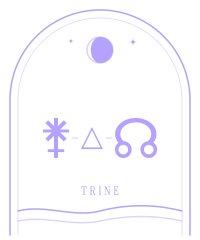
Juno trine Node in synastry means one partner's Juno sits about 120° from the other's North Node (orb ±8°), an angle read as flow. It turns up in 9.1% of couples born within five years of each other.
- In couples
- 9.1% about 1 in 11
- Either way round
- 17.19% both ways: 1.01%
- Angle
- 120° 4 signs apart · orb ±8°
- Birth time
- Not needed the date sets it
Simulation of 3 million couples, NASA JPL DE440.
Checked against chance
How common is Juno trine Node in synastry?
Juno and the North Node stood 120° apart in the sky in 1939–40, 1942–51, 1953–54, 1957–58 and 8 other stretches, so people born then carry the angle in their own chart. Between two people the share stays near the geometry, 0.2 points above it. Both ways at once — each partner's Juno to the other's North Node, the "double whammy" — in 1.01% of couples, about one in 99. The age gap changes little: 7.77% to 9.82% at any gap up to 40 years.
18 pages · printable
The 2027 Sky Calendar — free PDF
Every retrograde, eclipse, new and full moon of 2027 to the minute, already converted to your city. A month to a page, ready to print.
By sign
Which signs make Juno trine North Node
To check it by degree: Juno at 10° Pisces makes the trine with the North Node anywhere from 2° to 18° of Cancer or Scorpio — the 120° angle give or take 8°. The grid goes by sign, but the trine also forms across a sign line: Juno at 1° Pisces and the North Node at 29° Gemini are 118° apart, a square by sign.
Between two people
What does Juno trine Node mean in synastry?
Partnership supports growth: the commitment helps one or both people move toward the life they are meant to build. Committing to each other often coincides with important steps in life — a move, a new career, starting a family — and the partnership supports them.
The usual mistake
Where does Juno trine Node usually go wrong?
A commitment made at a turning point gets called destiny; when the turning point passes, the reason for it is hard to remember.
Over time
How Juno trine Node plays out over time
- Early on. The pair commit around a turning point — a move, a new career, a fresh start — and the timing feels right.
- Under pressure. The shared direction gives both a reason to work things out.
- Years in. The partnership is often tied to the life both went on to build, which keeps its meaning alive.
Juno and Node at other angles
At any angle: Juno, the commitment asteroid, meets the lunar Nodes, the axis of growth and direction. The contact links committing to this person with the path each is developing along.
Of the three Juno–North Node angles covered here, the trine is the one couples have most often, at 9.1%; the sextile is the rarest, at 6.62%.
Read next after Juno trine Node
Next to Juno trine Node in our list of 382, which runs from the most asked-about down.
Cite this page
AstroHot. “Juno Trine Node Synastry: Meaning and How Common It Is.” Accessed October 29, 2026. https://astrohot.com/synastry/aspects/juno-trine-node/
For Wikipedia
{{cite web |title=Juno Trine Node Synastry: Meaning and How Common It Is |url=https://astrohot.com/synastry/aspects/juno-trine-node/ |website=AstroHot |access-date=2026-10-29}}