Upper trigram
☳
Thunder (Zhen) above
Arousal and shock.
FamilyEldest son
ElementWood
Hexagram 62 of 64
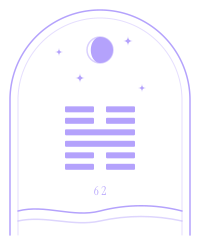
I Ching hexagram 62, Small Exceeding, is thunder above, mountain below. In brief: attend to small things, not large ones. Counting from the bottom, its solid lines sit in places 3 and 4 and its broken lines in 1, 2, 5 and 6.
Legge, The Yî King, 1882.
Upper trigram
Arousal and shock.
Lower trigram
Stillness and limit.
18 pages · printable
Every retrograde, eclipse, new and full moon of 2027 to the minute, already converted to your city. A month to a page, ready to print.
What the text says, in plain terms
The Judgement
Small exceeding: a time for small things, not great ones. Like a bird that should stay low rather than fly high, modest actions succeed and ambitious ones do not.
The Image
Thunder on a mountain, heard only nearby. The lesson is to be a little more careful, humble and thrifty than usual.
A summary of meaning written for this site, not a translation — James Legge’s 1882 translation of the full text follows below. How the Judgement and the Image are read, and which translations to use →
Primary source
“Hsiâo Kwo indicates that (in the circumstances which it implies) there will be progress and attainment. But it will be advantageous to be firm and correct. (What the name denotes) may be done in small affairs, but not in great affairs. (It is like) the notes that come down from a bird on the wing;—to descend is better than to ascend. There will (in this way) be great good fortune.”
“(The trigram representing) a hill and that for thunder above it form Hsiâo Kwo. The superior man, in accordance with this, in his conduct exceeds in humility, in mourning exceeds in sorrow, and in his expenditure exceeds in economy.”
Keep it small. Attend to details, be conscientious and postpone the big leap.
Small courtesies and attentiveness carry the relationship now. Grand plans can wait.
Detail work, minor improvements and careful housekeeping. Avoid overreaching.
Read from the bottom up. This figure runs yin yin yang yang yin yin — what each position means.
2 yang and 4 yin lines. Three of the six stand in their proper place, and the pairs 1–4 and 3–6 answer.
Mountain below — stillness and limit — is the private, inner side of hexagram 62.
Thunder above — arousal and shock — is the world that side meets.
Wood above controls Earth below. Circumstance restrains the inner position — pressure comes from the situation, not from within.
The eldest son sits above and the youngest son below. Two brothers, the older one on top — siblings rather than parent and child, so the order is one of seniority, not authority.
Calculated from the lines
Nuclear hexagram
What is happening beneath the surface.
Lines 2–4 give Xun (Wind) as the lower trigram, lines 3–5 give Dui (Lake) as the upper.
Opposite hexagram
The situation turned inside out.
Change all six lines and Thunder over Mountain becomes Wind over Lake.
Inverse hexagram
Hexagram 62 reads the same upside down: Thunder over Mountain, turned over, is still Thunder over Mountain. Only eight of the sixty-four do.
None of these are assigned by an author — each follows from the arrangement of lines.
Thunder above, Mountain below.
Thunder over Mountain: arousal and shock meeting stillness and limit.
Statements of fact on this page were checked against these sources in October 2026. How we choose and check sources: editorial policy.
AstroHot. “I Ching Hexagram 62: Small Exceeding.” Accessed October 27, 2026. https://astrohot.com/i-ching/hexagram/62/
{{cite web |title=I Ching Hexagram 62: Small Exceeding |url=https://astrohot.com/i-ching/hexagram/62/ |website=AstroHot |access-date=2026-10-27}}
Free · PDF · 18 pages
Every retrograde, eclipse, new and full moon of 2027 — to the minute, printed in your own time zone.