Upper trigram
☲
Fire (Li) above
Clarity and attachment.
FamilyMiddle daughter
ElementFire
Hexagram 38 of 64
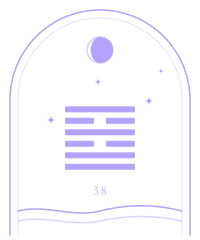
I Ching hexagram 38, Opposition, is fire above, lake below. In brief: two forces facing different ways. Counting from the bottom, its solid lines sit in places 1, 2, 4 and 6 and its broken lines in 3 and 5.
Legge, The Yî King, 1882.
Upper trigram
Clarity and attachment.
Lower trigram
Joy and openness.
18 pages · printable
Every retrograde, eclipse, new and full moon of 2027 to the minute, already converted to your city. A month to a page, ready to print.
What the text says, in plain terms
The Judgement
Opposition: people pulling in different directions. Large joint efforts are unlikely to succeed, but small matters can still go well.
The Image
Fire above and a lake below, moving apart. The lesson is to keep your own individuality while still living alongside those who differ.
A summary of meaning written for this site, not a translation — James Legge’s 1882 translation of the full text follows below. How the Judgement and the Image are read, and which translations to use →
Primary source
“Khwei indicates that, (notwithstanding the condition of things which it denotes), in small matters there will (still) be good success.”
“(The trigram representing) fire above, and that for (the waters of) a marsh below, form Khwei. The superior man, in accordance with this, where there is a general agreement, yet admits diversity.”
Accept that full agreement is not available right now. Focus on small, achievable steps and on respecting differences rather than erasing them.
Misunderstanding and diverging views. Common ground exists in small things even when big things divide.
Conflicting priorities between departments or partners. Aim for limited cooperation rather than grand unified plans.
Read from the bottom up. This figure runs yang yang yin yang yin yang — what each position means.
4 yang and 2 yin lines. One of the six stands in its proper place, and the pairs 2–5 and 3–6 answer.
Lake below — joy and openness — is the private, inner side of hexagram 38.
Fire above — clarity and attachment — is the world that side meets.
Fire above controls Metal below. Circumstance restrains the inner position — pressure comes from the situation, not from within.
The middle daughter sits above and the youngest daughter below. Two sisters, the older one on top — siblings rather than parent and child, so the order is one of seniority, not authority.
Calculated from the lines
Nuclear hexagram
What is happening beneath the surface.
Lines 2–4 give Li (Fire) as the lower trigram, lines 3–5 give Kan (Water) as the upper.
Opposite hexagram
The situation turned inside out.
Change all six lines and Fire over Lake becomes Water over Mountain.
Inverse hexagram
The situation seen from the other side.
Turn the figure upside down and Fire over Lake becomes Wind over Fire.
None of these are assigned by an author — each follows from the arrangement of lines.
Fire above, Lake below.
Fire over Lake: clarity and attachment meeting joy and openness.
Statements of fact on this page were checked against these sources in October 2026. How we choose and check sources: editorial policy.
AstroHot. “I Ching Hexagram 38: Opposition.” Accessed October 27, 2026. https://astrohot.com/i-ching/hexagram/38/
{{cite web |title=I Ching Hexagram 38: Opposition |url=https://astrohot.com/i-ching/hexagram/38/ |website=AstroHot |access-date=2026-10-27}}
Free · PDF · 18 pages
Every retrograde, eclipse, new and full moon of 2027 — to the minute, printed in your own time zone.